
Ozempic Tracker - log injections, weight, and side effects
Ozempic is a once-weekly injection of semaglutide. This page explains how to track an Ozempic treatment with Dosley and links every medical fact to the FDA-approved label.
Ozempic is the brand name for semaglutide, a once-weekly injectable medicine prescribed alongside diet and exercise to improve blood sugar in adults with type 2 diabetes. Because each treatment plan looks slightly different - different starting amounts, titration schedules, and side-effect timelines - keeping a personal log helps you and your prescriber see how things are going. Dosley is a private tracker for your injections, weight changes, and side-effect notes. It is not a medical device and does not give medical advice. The information below summarises the publicly available FDA-approved label so the page sits next to your tracker rather than inside it. If anything here differs from what your clinician has told you, follow your clinician.
At a glance
- Active ingredient
- Semaglutide 1
- Drug class
- GLP-1 receptor agonist 1
- Manufacturer
- Novo Nordisk 2
- FDA approval
- December 2017 (NDA 209637) 3
- Indication
- Adjunct to diet and exercise for type 2 diabetes in adults; reduces risk of major cardiovascular events in adults with established cardiovascular disease 1
- Schedule
- Once weekly, subcutaneous injection 1
- Starting dose
- 0.25 mg once weekly 1
- Maximum adult dose
- 2 mg once weekly 1
- Missed-dose window
- Within 5 days of the scheduled day 1
- Storage
- Refrigerated at 2–8°C until first use; in-use room-temperature limits given on the label and patient leaflet 1
Important safety information
In rodents, semaglutide causes dose-dependent and treatment-duration-dependent thyroid C-cell tumors at clinically relevant exposures. It is unknown whether Ozempic causes thyroid C-cell tumors, including medullary thyroid carcinoma (MTC), in humans. Ozempic is contraindicated in patients with a personal or family history of MTC and in patients with Multiple Endocrine Neoplasia syndrome type 2. 1
Contraindications
Common side effects
Discuss benefits and risks with your healthcare provider before starting or continuing this medication.
Dosing and titration
Your prescriber decides every step on the schedule below. The summary here is for orientation while you log treatments - it is not a recommendation.
Treatment begins at 0.25 mg once weekly for four weeks. After that the prescriber may increase to 0.5 mg, then to 1 mg, and if additional glycemic control is needed, to 2 mg, with at least four weeks on each step before any further increase. 1
The 0.25 mg starting amount is intended to help the body adjust before any glycemic target is set. It is not the maintenance amount. 1
When you record a treatment in Dosley, you can attach the amount, the day, and any notes about how you tolerated it. The app does not change your schedule - it only records what your prescriber has set.
Injection sites and storage
Ozempic is given by subcutaneous injection in the abdomen, thigh, or upper arm. Rotating sites between treatments is recommended in the prescribing information. 1
Pens should be kept refrigerated between 2°C and 8°C until first use. After first use, the prescribing information sets an in-use window at room temperature - follow the limit printed on your packaging or in the patient leaflet. 1
Tracking injection sites and storage windows in Dosley is optional but useful - it gives you a quick view of which sites you have used recently and when a pen needs to be retired or moved.
Ozempic and Wegovy
Ozempic and Wegovy contain the same active ingredient. They are different brand names with different FDA-approved indications.
Semaglutide is sold as Ozempic for type 2 diabetes and as Wegovy for chronic weight management in adults who meet the indication criteria. Each brand has its own FDA-approved labeling, packaging, and patient leaflet, and the maintenance amounts differ. 1 3
Whether you have been prescribed one or the other is a question for your clinician. Dosley supports tracking either brand and treats them as separate treatments.
Missed dose
If an Ozempic injection is missed, the FDA label allows it to be taken as soon as possible within 5 days of the scheduled day. After that window, skip the missed amount and resume on the next regular day. 1
About this medication and Dosley
How often is Ozempic injected?
Ozempic is a once-weekly subcutaneous injection. Your prescriber sets the day of the week and the amount; Dosley records what they have set so you can see your history. 1
What if I forget my Ozempic on the scheduled day?
The FDA-approved label states the missed amount may be taken within 5 days of the scheduled day. After that window the missed amount is skipped and you wait until the next regular day. If you are unsure, contact your clinician. 1
What are the most common Ozempic side effects?
In the FDA label's adverse-reaction tables, the most common side effects at the 1 mg amount were nausea (about 20%), vomiting (about 9%), diarrhea (about 9%), abdominal pain (about 6%), and constipation (about 3%). Logging side effects in Dosley helps you and your prescriber spot patterns. 1
Is Ozempic the same molecule as Wegovy?
Yes. Both Ozempic and Wegovy contain semaglutide, but each has its own FDA approval, indication, and maintenance amount: Ozempic is approved for type 2 diabetes and Wegovy is approved for chronic weight management. Speak to your clinician about which is appropriate for your situation. 3
Where is Ozempic injected?
The label specifies subcutaneous injection in the abdomen, thigh, or upper arm, with site rotation. Dosley lets you tag the site for each entry so you can see at a glance where you have already injected. 1
How should Ozempic be stored?
The FDA label says Ozempic should be kept refrigerated between 2°C and 8°C until first use. The in-use room-temperature window is set by the label and the patient leaflet that came with your pen - check that for the exact number of days. 1
Does Dosley send my Ozempic data to my clinic?
No. Dosley is a personal tracker. Your treatment log lives in your Dosley account, and you choose whether to export it as a PDF to share with your clinician. Talk to your healthcare team before changing anything in your treatment. 1
How Dosley supports an Ozempic routine
Dosley is built for the small rituals of a once-weekly injection routine. The home screen shows your next scheduled day so you never have to count from the calendar, and a quick log entry takes about five seconds - pick the day, the amount you were prescribed, the site, and you are done.
Side-effect notes live next to each entry. Many people find that the early weeks of a new amount bring temporary changes in how they feel; logging those alongside the entry helps you and your prescriber see whether things are settling or whether the schedule needs adjusting.
Weight is tracked in the same place. Manual entry is two taps; a chart shows the trend rather than the daily noise, so a single bad-scale day does not break your week. If you use Apple Health, weight syncs automatically.
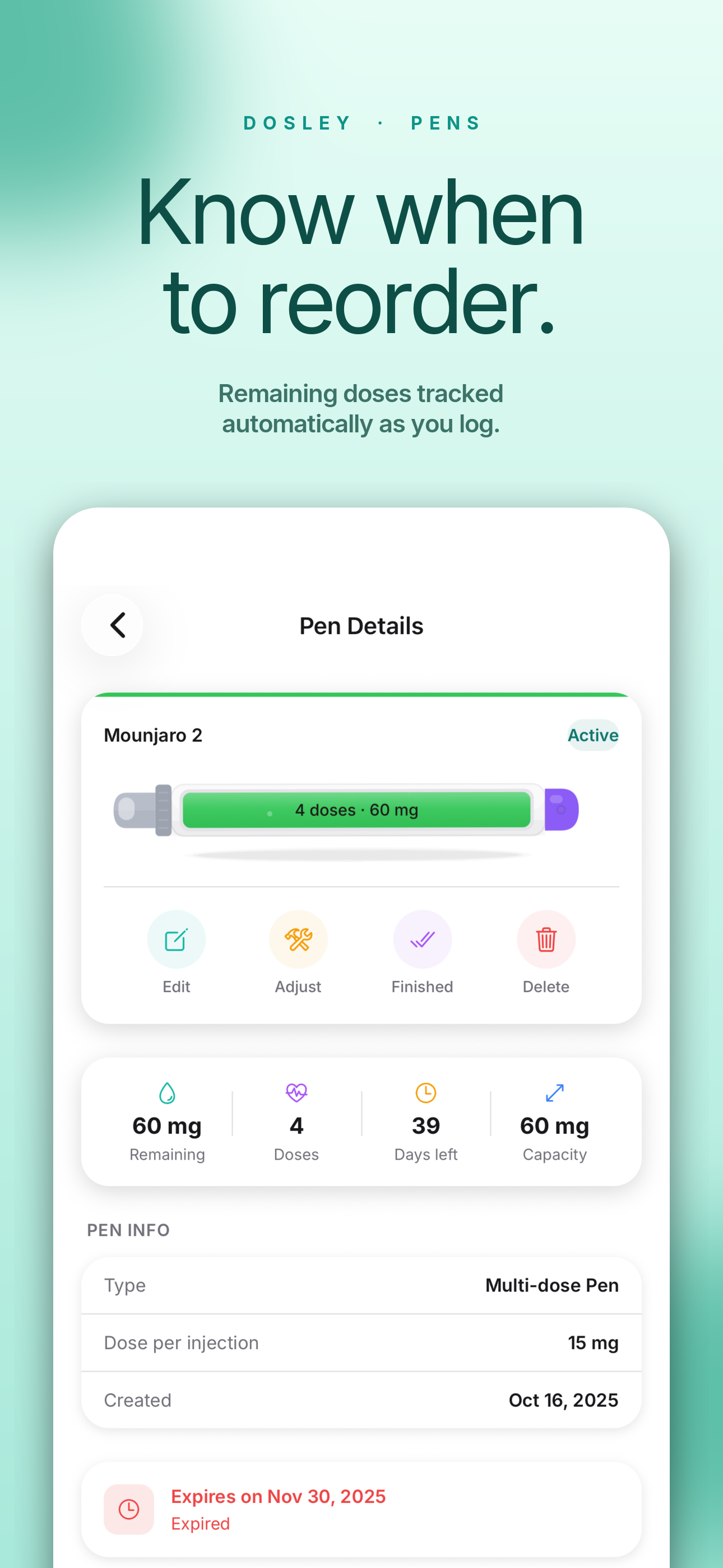
Pen tracking helps with the practical side. Dosley remembers which pen is open and how many uses are left, so you know when to fetch a new one from the fridge. Storage windows are reminders, not rules - always follow the leaflet that came with your medication.
Everything stays on your device unless you choose otherwise. There is no clinic dashboard, no advertiser, and no requirement to create an account. If your healthcare team asks for a summary, you can export a PDF from the app and share it on your terms.
Track your treatment with Dosley
Log injections, weights, and side effects in a private space designed for GLP-1 routines.
References
- 1. FDA-approved Ozempic (semaglutide) prescribing information (DailyMed)
- 2. Ozempic USPI (Novo Nordisk A/S)
- 3. Drugs@FDA: Ozempic (NDA 209637)
Last reviewed:
Ozempic is a registered trademark of Novo Nordisk A/S. Dosley is not affiliated with, endorsed by, or sponsored by Novo Nordisk A/S.